FAQ
Credit ratings often raise questions, especially when a company’s own experience of its business situation does not seem to match the assigned risk category. Valuatum’s credit rating is based on statistical analysis that takes into account the company’s financial ratios, balance sheet, liquidity, industry risk level, and other factors affecting its ability to absorb risk.
On this page, we have compiled the most common questions and answers about how credit ratings are determined and why the results may sometimes be surprising.
Frequently Asked Questions
The chart below illustrates how Danish companies are positioned in Valuatum’s rating model based on key financial indicators. In the chart, each point represents one company:
- The horizontal axis shows profitability (return on assets).
- The vertical axis shows solvency (equity ratio).
Companies located in the upper-right corner are typically both profitable and financially solid, while those in the lower-left corner tend to have weaker profitability and solvency. The color of each point indicates the company’s credit rating: green companies represent lower risk, while red companies represent higher risk.
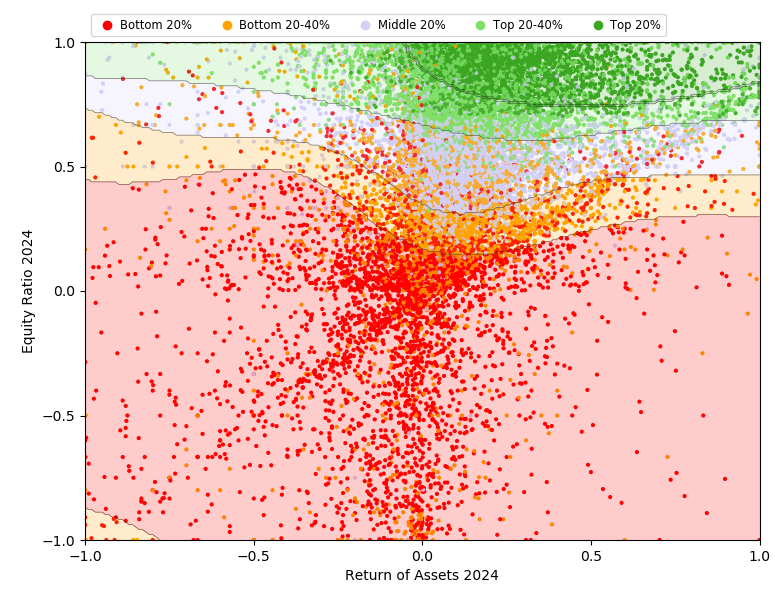
The background color areas indicate which rating is most typical for companies with those particular financial metrics.
If a company’s situation is otherwise typical (meaning there are no exceptional risk factors), the chart provides a good indicative view of the rating level a company would usually fall into.
If the example company’s figures are otherwise neutral, achieving an “A”-level rating (placing it among the top 20% of Danish companies) typically requires an equity ratio of 75–100% and a positive return on equity.
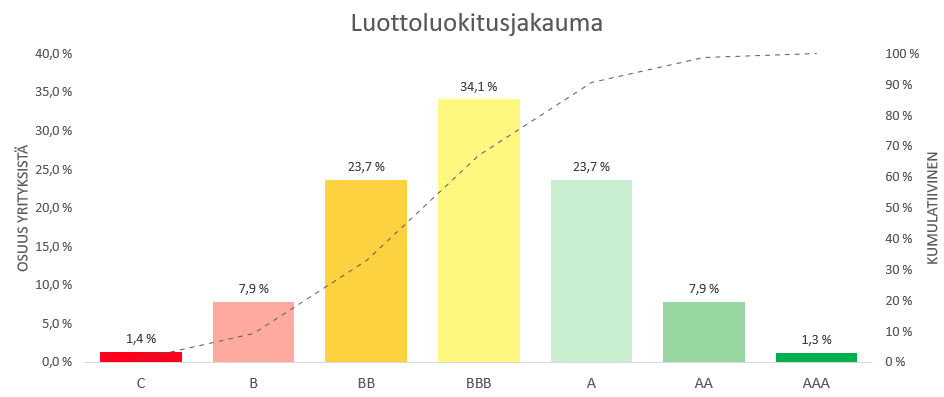
In Valuatum’s model, ratings are calibrated so that only about one third of companies fall into the A categories (see the distribution below). This is broadly consistent with the distributions used by international credit rating agencies such as Standard & Poor’s.
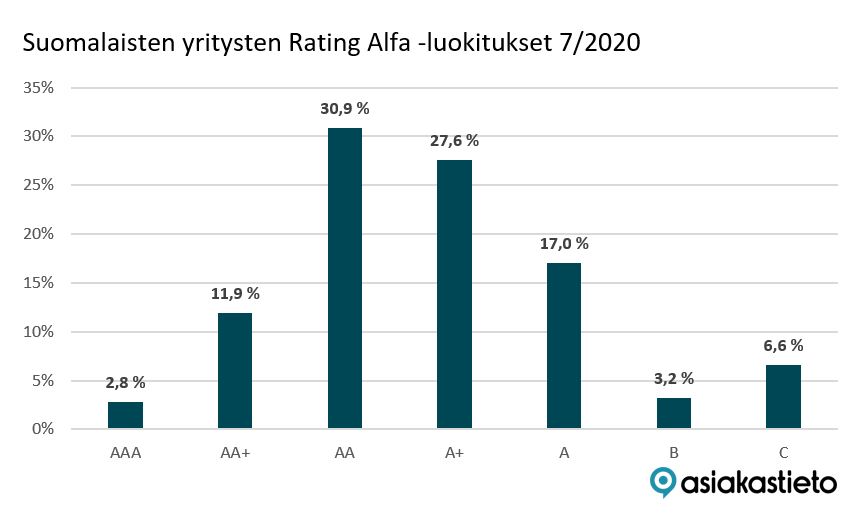
By contrast, some competing services in Finland for example, classify around 90% of Finnish companies into A categories.
In practice, this means that the same company may receive different ratings across different services. Valuatum’s rating may appear lower even though the company’s relative risk level is the same.
The difference does not necessarily reflect a different assessment of the company’s risk, but rather how ratings are distributed across the overall population of companies.
Valuatum’s credit rating distribution
Source: Valuatum
S&P’s credit rating distributionSource: Business Insider
Asiakastieto’s credit rating distribution (owner of Proff.dk)
Source: Kauppalehti
Yes. Different providers use different models, weightings, and data sources, so the same company may receive different ratings across different services.
These differences do not necessarily mean that one assessment is “wrong.” Rather, they reflect different approaches to evaluating risk. A credit rating is always a model-based estimate of how a company compares with other companies and with observed historical risk patterns.
How Credit Ratings Are Determined
Valuatum’s credit rating is based on a statistical risk model that makes extensive use of historical data on Finnish companies, including financial statements, payment default records, and bankruptcy data. The model estimates the probability that companies with a given profile will experience payment defaults or bankruptcy risk.
The rating is not based on a single financial metric, but on an overall assessment. In particular, the model considers factors such as solvency, profitability, liquidity, balance sheet structure, industry risk level, and several other indicators that describe a company’s ability to absorb risk.
Typically, the most important factors include:
- Solvency, especially the equity ratio
- Profitability, such as return on capital
- Liquidity, for example the size of cash reserves relative to business volume and short-term liabilities
- Balance sheet structure, such as how assets are distributed between cash, receivables, and other items
- Industry risk, meaning how frequently companies in that particular industry fail on average
In practice, a strong rating usually requires that a company has both healthy profitability and sufficient financial buffers relative to the risks of its business operations.
Not on its own. Company-specific factors remain very important and play a major role in determining the rating. However, industry risk influences how high the bar is for achieving a strong rating.
In other words, with the same level of profitability and solvency, a company operating in a lower-risk industry may receive a better rating than a company in a higher-risk industry.
That said, every industry contains both highly rated and weakly rated companies.
A credit rating should be viewed as a condensed risk signal, not as a final judgment about the quality of a company. It indicates how the company statistically compares with other companies and what level of risk is associated with its financial ratios, balance sheet, and industry.
At its best, a credit rating helps company management understand:
- which factors strengthen the company’s position
- which factors limit its financing capacity
- what areas of development could improve the company’s risk profile
Cash reserves and liquidity influence how well a company can withstand everyday disruptions, delays, and unexpected events. If a company has a large business volume but only small cash buffers, its ability to cope with temporary problems may be weaker.
The model examines, among other things, cash in relation to revenue, expenses, short-term liabilities, and other balance sheet items. Strong liquidity supports the rating because it improves the company’s resilience to disruptions.
Why a Credit Rating May Be Weak
Profitability is an important factor, but it does not determine the credit rating on its own. A company may have good results yet still receive a modest rating, for example if:
- equity is small relative to the scale of the business
- cash buffers are thin
- the industry carries higher-than-average risk
- the balance sheet does not provide sufficient protection against potential disruptions
A credit rating primarily measures a company’s ability to absorb risk. Even a profitable business can appear vulnerable from a lender’s perspective if a single bad year or the failure of one major project would have a large impact.
The equity ratio indicates relative solvency, but on its own it does not show how large the company’s actual financial buffer is in absolute terms.
A company may have a high equity ratio, but if the balance sheet is small while the business volume is large, the owners’ ability to absorb risk may still be limited. From a lender’s perspective, it is often also important how much equity and other protective assets the company has in absolute terms.
Yes, it can. Industry risk is an important part of credit risk assessment, because the frequency of bankruptcies and payment defaults varies significantly across industries.
If an industry is riskier than average, a company typically needs stronger financial metrics to reach the same credit rating as a company operating in a lower-risk industry. This does not mean that the industry alone determines the rating, but it raises the bar.
Not necessarily. A weak or below-average rating does not automatically mean that the company’s business is poor or that the company is in immediate danger.
It usually means that, statistically speaking, the company’s risk level is higher than that of better-rated companies. This may be due to factors such as a higher-risk industry, small absolute equity, limited cash buffers, or the size of the balance sheet relative to the scale of the business.
Changes and Dynamics
A credit rating can change if a company’s financial metrics change or if the business environment changes. For example:
- profitability improves or weakens
- equity increases or decreases
- cash reserves strengthen or decline
- the risk level of the industry changes
- business volume grows faster than the company’s financial buffers
In some industries, economic cycles also have a strong impact. In such cases, even with similar company-specific figures, the overall risk level may differ from year to year.
What You Can Do
Yes, it can. A credit rating can usually be improved by strengthening the company’s ability to absorb risk. In practice, the most important factors often include:
- strengthening equity
- increasing cash buffers
- improving profitability
- strengthening the balance sheet relative to the scale of the business
- improving risk management and the predictability of business operations
Especially in higher-risk industries, strong equity and sufficient financial buffers become particularly important.
Yes. In addition to the credit rating, many other factors influence access to financing, such as banks’ own risk policies, regulation, collateral requirements, market conditions, and the overall cycle of the industry.
For this reason, it is possible that a well-managed company may face stricter financing terms than its operational quality alone would suggest. A credit rating is an important part of the assessment, but it is not the only factor in lending decisions.